SEARCH WHAT YOU WANT
Electronic Protection
F-100A
Electronic Hearing Protection Earmuff
Color: Black / White / Camo

Color: Black / White / Camo
Description
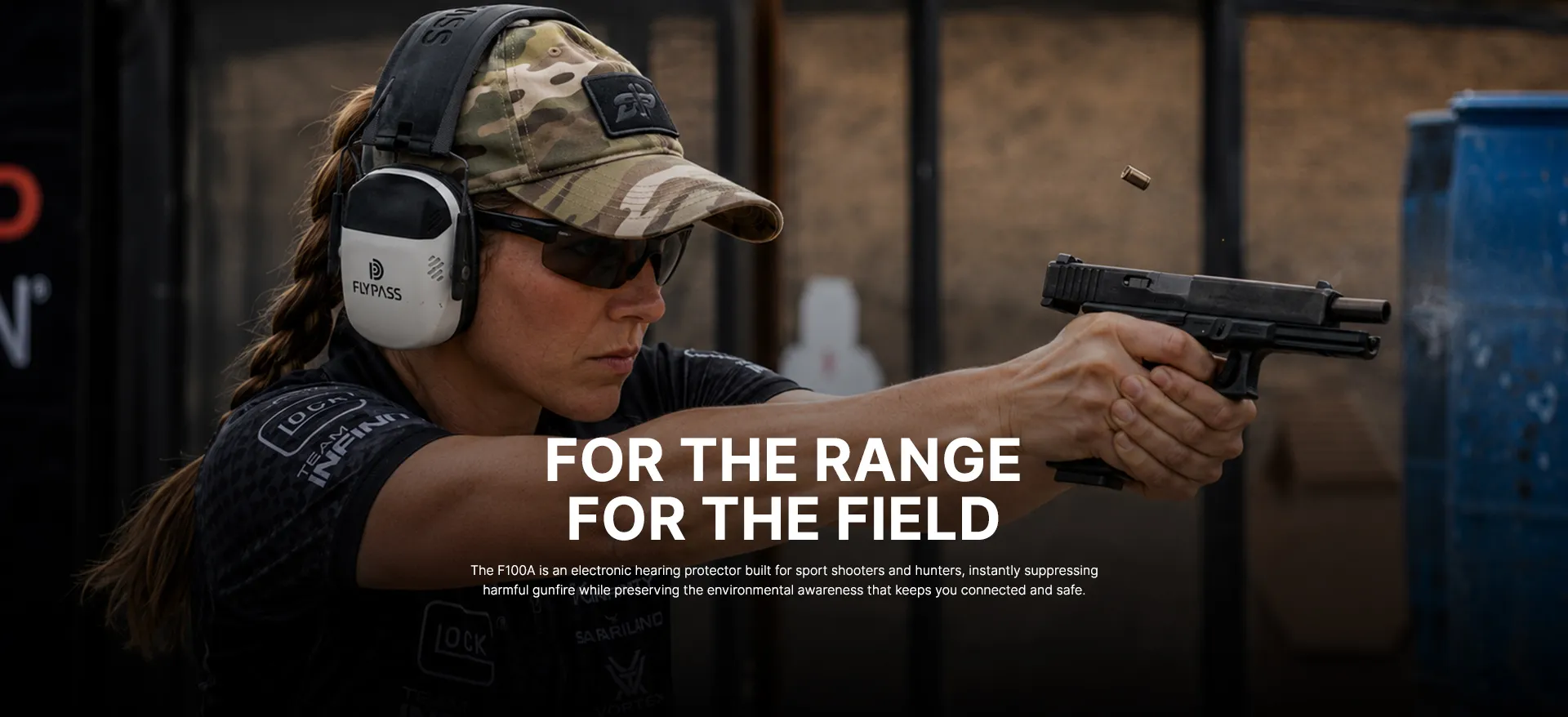
The FLYPASS® F-100A is a professional electronic hearing protector engineered for shooting sports enthusiasts and range training. Featuring <1ms attack time sound compression technology and ambient sound amplification, it delivers reliable hearing protection (NRR 23dB) while maintaining full situational awareness and clear communication. Premium soft cushions ensure acoustic seal and all-day comfort. Powered by 2xAAA supports extended range sessions without interruption.
Product Details
ㅤKey Features
Professional-Grade NRR 23dB Protection
NRR 23dB certified by ANSI S3.19-1974
Ambient Sound Amplification
Dual high-gain omnidirectional microphones (one per ear)
Sound amplification of ambient sounds below 85dB
Rotary Knob Intuitive Operation
One-knob integrated control: Power + Volume in a single recessed rotary knob
Ergonomic Design
Adjustable length headband design: Fits different head circumference
Wide and thick ear pad design: ensures more uniform pressure distribution during wearing
Professional-Grade NRR 23dB Protection
NRR 23dB certified by ANSI S3.19-1974
Ambient Sound Amplification
Dual high-gain omnidirectional microphones (one per ear)
Sound amplification of ambient sounds below 85dB
Rotary Knob Intuitive Operation
One-knob integrated control: Power + Volume in a single recessed rotary knob
Ergonomic Design
Adjustable length headband design: Fits different head circumference
Wide and thick ear pad design: ensures more uniform pressure distribution during wearing
ㅤFeatures
○ Professional-Grade NRR 23dB Protection
○ Ambient Sound Amplification
○ Rotary Knob Intuitive Operation
○ Ergonomic Design
○ <1ms Instant Suppression Above 85dB
○ Slim Profile Design with Compact Folding
○ Power by 2×AAA battery
○ Universal 3.5mm AUX Input
○ 4+ Appearance Options
○ Custom patch Velcro area on headband
○ Professional-Grade NRR 23dB Protection
○ Ambient Sound Amplification
○ Rotary Knob Intuitive Operation
○ Ergonomic Design
○ <1ms Instant Suppression Above 85dB
○ Slim Profile Design with Compact Folding
○ Power by 2×AAA battery
○ Universal 3.5mm AUX Input
○ 4+ Appearance Options
○ Custom patch Velcro area on headband
ㅤFQA
Q: How is the noise cancellation performance of the F-100A?
The F-100A has an NRR (Noise Reduction Rating) of 23dB, suitable for typical training shooting scenarios.
Q: What are SNR and NRR values, and what is the difference between them?
Both are indicators of hearing protection. NRR (Noise Reduction Rating) is mainly used for ANSI certification in the United States. SNR (Single Number Rating) is mainly used for CE certification in Europe. There is no precise conversion formula between these two values, but SNR values are generally about 3-7 dB higher than NRR values.
Q: How do I charge the headphones?
The headphones are powered by two AAA batteries and do not require charging.
Q: How do I maintain my F-100A headphones?
Please regularly clean and disinfect the earcups, headband, and ear pads with a damp cloth dampened with soapy or warm water. Ensure the soapy water is harmless to the user. Allow the earcups to air dry before use.
Do not soak the earcups in water!
Q: Can the ear pads of the headphones be replaced?
Yes, you can purchase ear pad replacement parts to attach to the headphones. If you use hearing protection headphones daily, we recommend replacing the ear pads regularly.
Q: How should I wear headphones to achieve hearing protection?
For best protection, the ear pads should fit snugly against your head. Anything that interferes with the seal, such as long hair, thick or ill-fitting glasses, a pencil clipped to your ears, or a hat, can reduce hearing protection.
Q: What can I do if my hearing protection is still insufficient even after wearing noise-canceling headphones correctly?
For high-decibel noise (e.g., above 130dB), we recommend wearing hearing protection earplugs in addition to the headphones to improve hearing protection.
Q: How is the noise cancellation performance of the F-100A?
The F-100A has an NRR (Noise Reduction Rating) of 23dB, suitable for typical training shooting scenarios.
Q: What are SNR and NRR values, and what is the difference between them?
Both are indicators of hearing protection. NRR (Noise Reduction Rating) is mainly used for ANSI certification in the United States. SNR (Single Number Rating) is mainly used for CE certification in Europe. There is no precise conversion formula between these two values, but SNR values are generally about 3-7 dB higher than NRR values.
Q: How do I charge the headphones?
The headphones are powered by two AAA batteries and do not require charging.
Q: How do I maintain my F-100A headphones?
Please regularly clean and disinfect the earcups, headband, and ear pads with a damp cloth dampened with soapy or warm water. Ensure the soapy water is harmless to the user. Allow the earcups to air dry before use.
Do not soak the earcups in water!
Q: Can the ear pads of the headphones be replaced?
Yes, you can purchase ear pad replacement parts to attach to the headphones. If you use hearing protection headphones daily, we recommend replacing the ear pads regularly.
Q: How should I wear headphones to achieve hearing protection?
For best protection, the ear pads should fit snugly against your head. Anything that interferes with the seal, such as long hair, thick or ill-fitting glasses, a pencil clipped to your ears, or a hat, can reduce hearing protection.
Q: What can I do if my hearing protection is still insufficient even after wearing noise-canceling headphones correctly?
For high-decibel noise (e.g., above 130dB), we recommend wearing hearing protection earplugs in addition to the headphones to improve hearing protection.
|
|
|



|
|
|